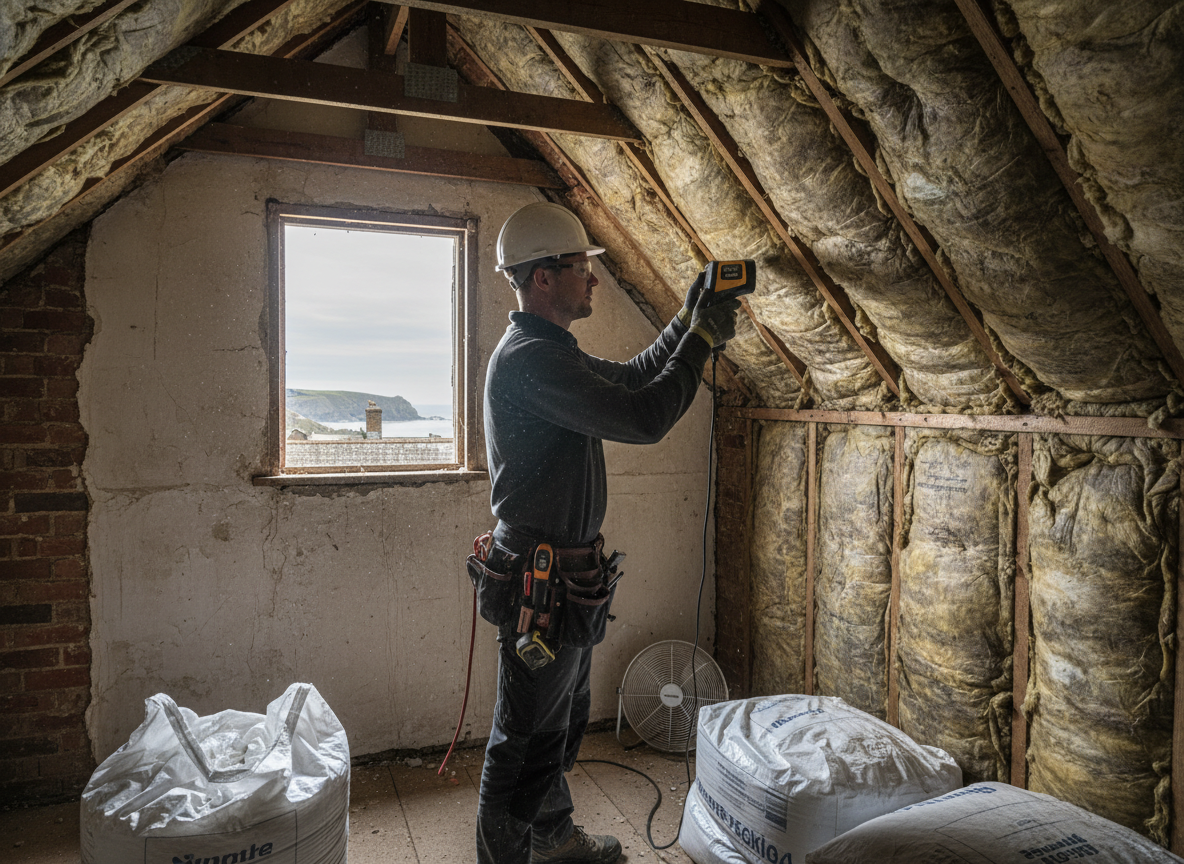
Torquay's older housing stock, particularly the Victorian and Edwardian terraces common along The Terrace and in areas like St Marychurch, often received spray foam insulation in lofts or walls during the 1990s and 2000s. Coastal humidity and salt-laden air accelerate foam shrinkage and delamination, trapping moisture against timber joists and leading to rot that standard visual checks miss. An insulation assessment here starts with borescope inspection through existing vents and targeted moisture metering at roof junctions where condensation pools most readily during the region's frequent winter drizzle.
Edge cases arise in converted guest houses near Torre Abbey where multiple layers of foam were applied over decades, creating inconsistent thermal bridges that only show during thermal imaging on damp mornings. Regulations under current Building Regulations Part L require documentation of any remaining insulation performance before removal works begin, and assessors must flag where foam has bridged original ventilation paths in chimney breasts. Homeowners in the TQ1 postcode frequently overlook how rising damp from the area's clay subsoils interacts with foam edges at ground floor level, causing hidden mould that spreads upward through stud walls.
Proper assessment also maps access constraints typical of narrow Torquay back lanes, where scaffolding or cherry pickers may be needed for external wall checks without disturbing neighbouring properties. The process distinguishes between closed-cell and open-cell foam behaviours under local wind-driven rain exposure, informing whether full removal or targeted remediation is viable. Reports include annotated photos and moisture readings logged against each elevation, giving owners clear data on which sections require urgent attention before winter storms arrive.
Technician insight
In Torquay, the thing that catches most people out with insulation assessment is how salt air from the harbour accelerates foam breakdown along the seaward side of terraces like those on The Terrace, where moisture gets pulled in through failed pointing and stays trapped behind the foam in ways you never see on inland Devon properties.
Hidden Damp in a St Marychurch Terrace
The owner noticed musty smells in a top-floor bedroom of a Victorian terrace near St Marychurch. Our assessment found closed-cell foam had pulled away from rafters on the north elevation, allowing salt-laden air to condense against the sarking. We documented extensive timber staining and elevated moisture levels, then provided a removal plan that preserved the original roof ventilation.
How it works
- 1
Site Walkthrough
Examine all accessible loft spaces, wall cavities and roof voids in the Torquay property while noting original construction details.
- 2
Moisture and Thermal Survey
Deploy moisture meters and thermal imaging to locate hidden damp zones created by degraded spray foam.
- 3
Borescope and Sample Checks
Insert borescope cameras through small access points to inspect foam adhesion and timber condition without major disruption.
- 4
Report and Recommendations
Compile findings into a written report with photos, moisture data and clear next steps for removal or repair.
Pricing
Cost depends on property size, number of storeys and ease of access in Torquay terraces; contact us for an upfront assessment quote.