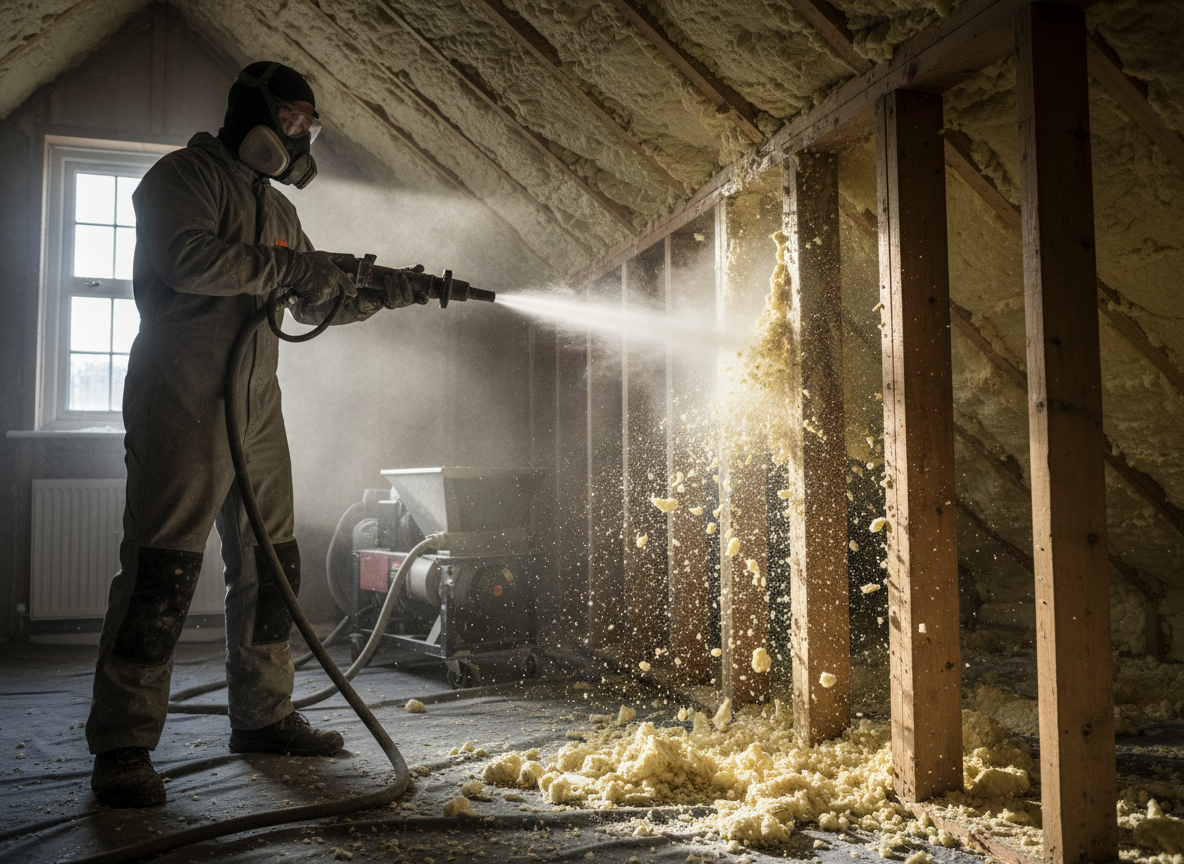
Torquay's Victorian and Edwardian terraces, common in areas like Babbacombe and St Marychurch, frequently received spray foam insulation in the 1990s and 2000s. Over time the closed-cell material traps moisture against rafters in the region's damp coastal climate, leading to timber decay and reduced ventilation. Dry ice blasting uses solid CO2 pellets accelerated at high velocity to shear the foam from timber and plaster without abrasion or chemical residues. The process requires careful containment because Torquay properties often have narrow loft hatches and shared party walls that allow dust migration into neighbouring homes.
Access constraints in these older buildings change the job on site. Low-pitched roofs along The Terrace and surrounding streets leave little headroom, so technicians must work from boards laid across joists while directing the blast nozzle at acute angles. Salt-laden air accelerates corrosion on any exposed metal fixings, so the blasting must stop short of nail plates and hangers. Post-removal inspection routinely reveals hidden rot in sarking boards that only becomes visible once the foam is gone, requiring separate timber treatment before new insulation can be considered.
Regulation in Devon requires that removed foam waste is handled as controlled waste, with proper bagging and licensed disposal to avoid landfill issues near the coast. Homeowners in flood-prone lower parts of Torquay also need to ensure the roof void is fully dried before re-insulating, as residual moisture from the blasting process can linger in the humid microclimate under the tiles.
Technician insight
In Torquay, the thing that catches most people out with dry ice blasting spray foam removal is how the narrow roof voids in 1890s terraces along The Terrace trap the spent pellets and foam dust against lath and plaster ceilings, requiring extra time to vacuum every crevice before the job is finished.
Condensation Fix in Babbacombe
A homeowner in a 1905 terrace reported persistent damp patches on bedroom ceilings. Inspection showed spray foam blocking all eaves ventilation. Dry ice blasting cleared the foam cleanly from the rafters. Restored airflow eliminated the condensation within weeks.
How it works
- 1
Site Assessment
Inspect loft access, roof structure and existing foam condition in the Torquay property.
- 2
Containment Setup
Seal hatches, party walls and vents to prevent CO2 pellet dust escaping into living spaces.
- 3
Dry Ice Blasting
Apply pellets at controlled pressure to remove foam from rafters and decking without surface damage.
- 4
Clearance and Disposal
Bag all debris and remove from site for licensed disposal under Devon waste rules.
- 5
Final Inspection
Check for hidden timber issues and confirm ventilation paths are restored.
Pricing
Cost depends on loft size, foam thickness and access difficulty in older Torquay terraces; upfront quote provided after inspection.