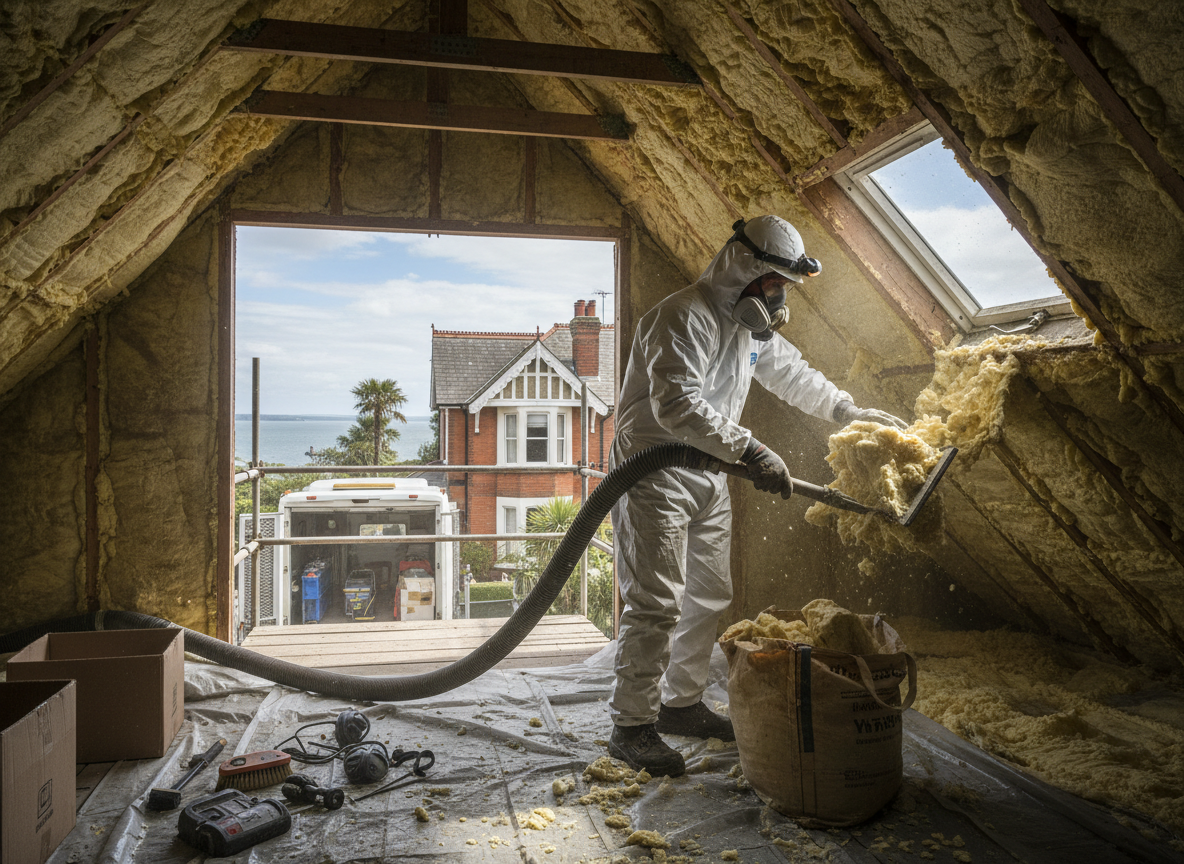
Torquay's Victorian and Edwardian terraces often received closed-cell spray foam in attics during the 2000s to meet energy targets. Over time the material bonds tightly to rafters and can seal in salt-laden air that drives timber decay and rust on metal ties. Removal starts with negative-pressure containment to stop dust migrating into living spaces below, followed by mechanical scraping and vacuum extraction that reaches between joists without damaging original lath and plaster ceilings common in TQ1 postcodes.
Coastal humidity and occasional heavy winter rain mean any remaining foam residue quickly reabsorbs moisture, so crews cut back insulation at the eaves to restore ventilation paths required by current Building Regulations. Waste is double-bagged on site and taken to licensed Devon facilities rather than skipped, avoiding the fly-tipping risks that have affected sites near the harbour. Homeowners in areas like St Marychurch or Chelston frequently discover hidden electrical cables and junction boxes once the foam is gone, requiring immediate isolation before work continues.
Handling Hidden Services and Damp
Before any scraping begins, a moisture meter survey maps wet spots along the north-facing slopes where driving rain enters through slipped tiles. Low-voltage cabling installed in the 1970s is common in these attics and must be traced and protected; crews carry insulated tools and stop work immediately if live circuits are exposed. After foam clearance, a temporary ridge vent is fitted to prevent condensation until permanent airflow is restored, a step that proves essential in Torquay's mild but damp winters.
Technician insight
In Torquay, the thing that catches most people out with Attic spray foam removal is how the salt air along the seafront terraces has already started corroding the metal ties once the foam is stripped away; you have to check every fixing before you leave or the roof can shift within a season.
Ellacombe terrace attic
Owner in an Ellacombe terrace reported persistent damp smells after years of foam insulation. Inspection found closed-cell foam sealing a cracked ridge tile and trapping rainwater against rafters. Crew removed the foam under negative pressure, cleared debris from the eaves and fitted temporary vents. Moisture readings dropped within days and no further rot appeared.
How it works
- 1
Site Assessment
Measure attic volume, locate services and test moisture levels across the roof structure in Torquay properties.
- 2
Containment Setup
Install sealed polythene barriers and negative air units to keep dust out of habitable rooms below.
- 3
Foam Extraction
Mechanically remove foam in sections, vacuum between joists and bag all waste for licensed disposal.
- 4
Ventilation Restoration
Clear eaves and install temporary ridge vents to restore airflow before leaving the property.
Pricing
Upfront quotes follow inspection; price moves with foam depth, attic access and any required service isolation in older Torquay terraces.